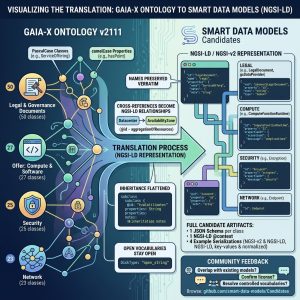
Smart Data Models’ Candidates repository now includes a new candidate standard, gaiax-ontology-v2111, translated from the Gaia-X ontology v2111 — the vocabulary behind Self-Descriptions in Gaia-X federated data spaces and cloud ecosystems. All 165 classes published at docs.gaia-x.eu/ontology/v2111/classes now have an NGSI-LD / NGSI-v2 representation.
What’s in it
Gaia-X’s ontology is broader than a typical device/observation vocabulary — it describes both the physical/technical side of an offering and the legal/governance claims attached to it. That split shows up directly in the model mix:
| Category | Models | Examples |
|---|---|---|
| Legal & governance documents | 50 | LegalDocument, TermsAndConditions, DataUsageAgreement, ServiceAgreementOffer |
| Compute & software | 27 | CPU, GPU, Memory, Hypervisor, ComputeFunctionRuntime, Image |
| Security | 25 | Encryption, PhysicalSecurity, InformationSecurityPolicies, ProductSecurity |
| Network | 23 | Endpoint, VLANConfiguration, InterconnectionServiceOffering, PointOfPresence |
| Infrastructure | 19 | Datacenter, AvailabilityZone, Region, PhysicalResource |
| Service offerings | 17 | ServiceOffering, ComputeServiceOffering, StorageServiceOffering |
| QoS metrics | 13 | Latency, Jitter, PacketLoss, Throughput, IOPS |
| Storage | 13 | BlockStorageConfiguration, ReplicationPolicy, SnapshotPolicy |
| Data products | 13 | DataProduct, DataProductCatalogue, EvidenceTemplate |
| Trust framework | 10 | Ecosystem, EcoTrustScope, EcoTSP, CompliantCredential |
| + identifiers, measurement, FaaS, environmental, and more | ~19 | VatID, EORI, EnergyMix, WaterUsageEffectiveness |
Every model ships the full set of Candidates artifacts: a JSON Schema, an NGSI-LD @context, and all four example serializations (NGSI-v2 and NGSI-LD, key-values and normalized) — each validated against its own schema.
Translation notes
- Names preserved verbatim. Gaia-X’s own class and property names (
hasPoint-style camelCase, PascalCase classes) are kept exactly as the ontology defines them — no forced renaming. - Cross-references become NGSI-LD Relationships. Any property whose range is another Gaia-X class (e.g.
Datacenter.aggregationOfResources→AvailabilityZone) is modeled as a Relationship, not an inlined object, so the resulting graph mirrors the ontology’s own linking structure. - Inheritance is flattened, not duplicated in text. A subclass’s schema only lists its own properties; inherited ones are documented on the parent model and referenced by name in the description, matching how the source ontology itself organizes properties.
- Open vocabularies stay open. A number of Gaia-X properties reference controlled vocabularies (e.g.
DiskType,HypervisorType) that aren’t enumerated on the class documentation pages themselves; those are modeled as open strings with a note in the description rather than an invented closed enum. - One naming collision, resolved explicitly.
DataUsageAgreement‘s owndataProviderproperty (the participant providing a Data Product) would collide with the Candidates convention’s boilerplatedataProvidermetadata field (harmonised-data-entity provider). It’s exposed asgxDataProviderinstead, with the substitution documented in the schema’s own description.
Try it, and tell us what’s missing
This is a Candidate — a first, carefully-sourced translation, not yet promoted to an official Smart Data Models subject. A few things are open and would benefit from community input before that step:
- Overlap with existing Smart Data Models subjects (
dataModel.Device, generic infrastructure/building vocabularies) hasn’t been checked in detail. - License terms for the specific v2111 release should be confirmed before promotion out of Candidates.
- A handful of controlled vocabularies referenced by the ontology (e.g. disk/hypervisor/firmware type enumerations) aren’t resolved to closed lists yet — see the individual schema descriptions for which ones.
Browse the models, open an issue, or send a PR: 👉 https://github.com/smart-data-models/Candidates/tree/master/standards/gaiax-ontology-v2111